



Advanced Permissions — Control Exactly Who Sees and Edits Every Field
Assign access at the Solution, Table, Field, and record level—so every Member sees exactly what their role requires, sensitive data stays protected, and administrators keep full oversight.
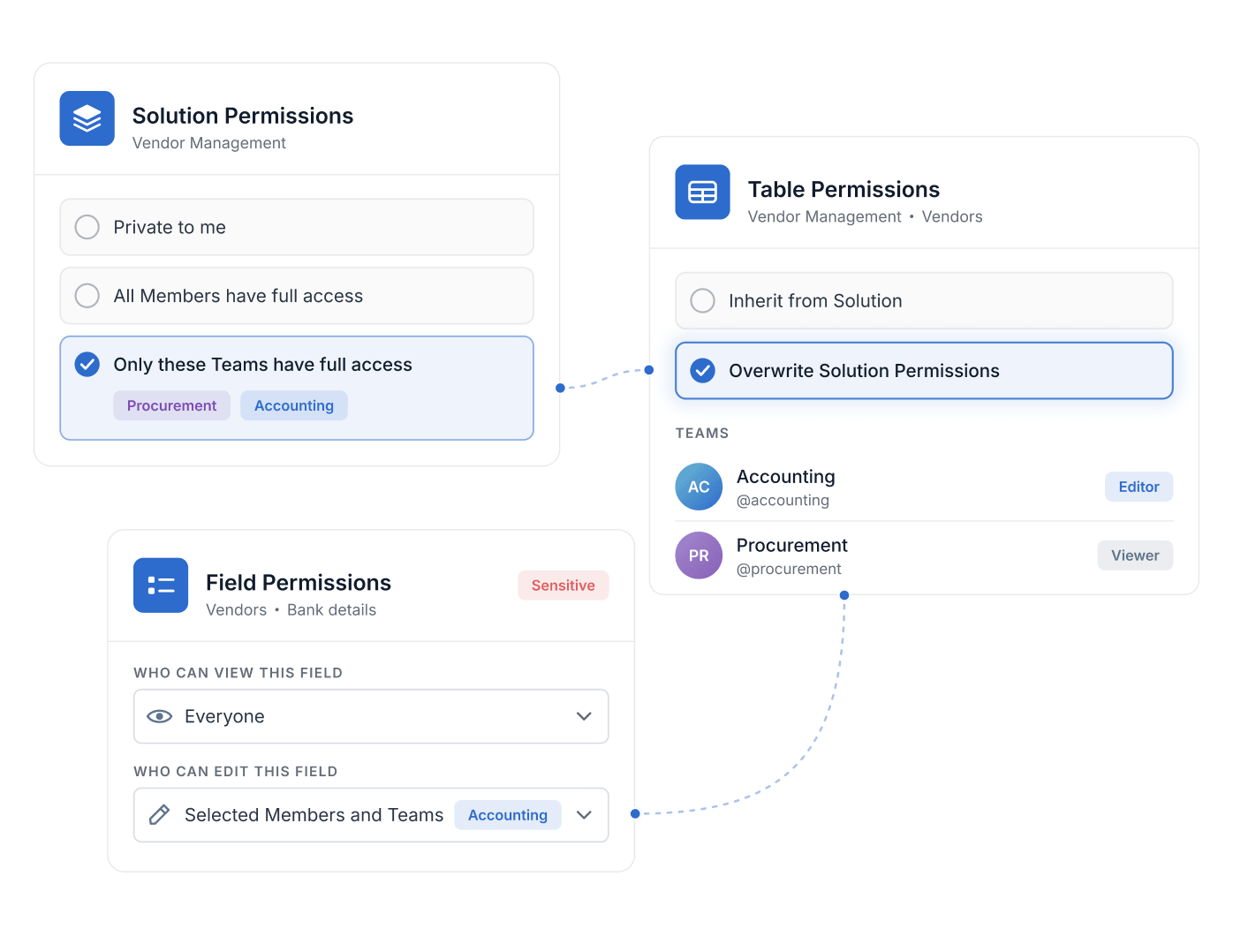
- Workspace roles are General Access, Solution Creator and Administrator; any member can be made a Solution Manager for a given Solution.
- Solution permissions are on every plan; Table and Field permissions are on Professional and Enterprise.
- Advanced permission levels run from Full Access through Editor, Contributor, Assignee, Assignee+ and Commenter to Viewer, set per member or Team.
- Field permissions set who can view and who can edit a field: everyone, everyone except, selected members and teams, or nobody.
- Dynamic record permissions on Enterprise and Signature restrict view, edit, create or delete at record, tab or section scope, always or when conditions are met.
What Is Advanced Permissions?
Advanced Permissions is SmartSuite's granular access-control system that lets Administrators and Solution Managers define who can view, create, edit, comment on, or delete data at the Solution, Table, Field, and record level. It helps GRC, IT, and business operations teams protect sensitive data while keeping everyday collaboration open—each Member works with exactly the access their role requires. Solution-level permissions are included on every plan; Table, Field, and record-level permissions are available on Professional and Enterprise plans, and Enterprise adds Dynamic Record Permissions.
Access Modes
Set Solution Access in Four Modes—From Private to Fully Custom
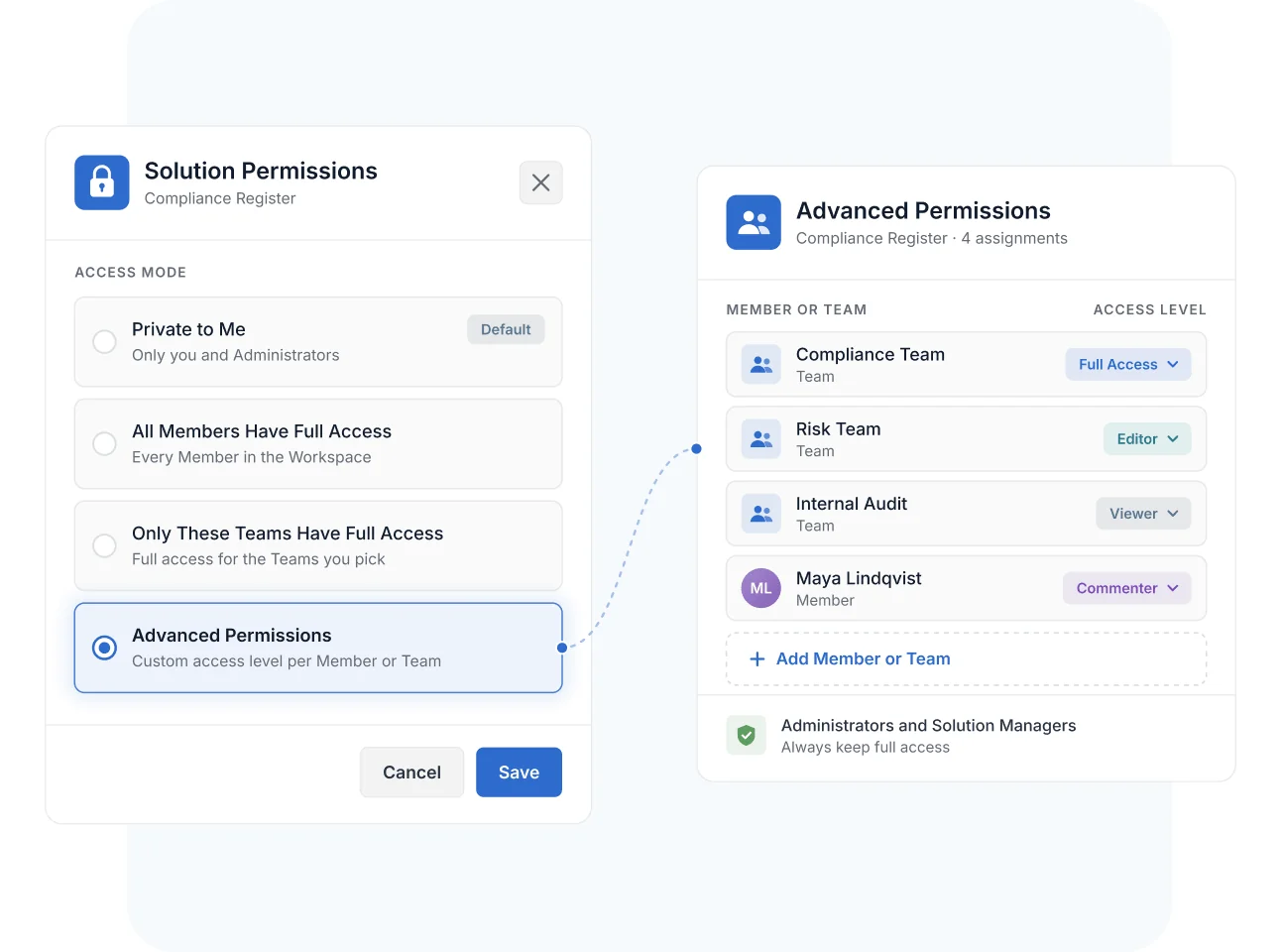
Every Solution starts private. From there, an Administrator or Solution Manager picks one of four access modes: Private to Me, All Members Have Full Access, Only These Teams Have Full Access, or Advanced Permissions—a fully custom assignment of access levels per Member or Team.
That means a new compliance register can stay locked to its owner while it's built, then open to precisely the Teams that need it—no blanket workspace access required.
Permission Tiers
Assign the Right Permission Level, From Full Access to Viewer
Advanced Permissions offers a spectrum of access tiers at the Solution and Table level: Full Access, Editor, Contributor, Assignee, Assignee+, Commenter, and Viewer. An Editor creates and edits their own records while seeing others read-only; an Assignee sees and edits only records assigned to them; a Commenter can discuss work without changing it.
When a Member holds multiple applicable levels, the highest one applies—so access resolves predictably every time.
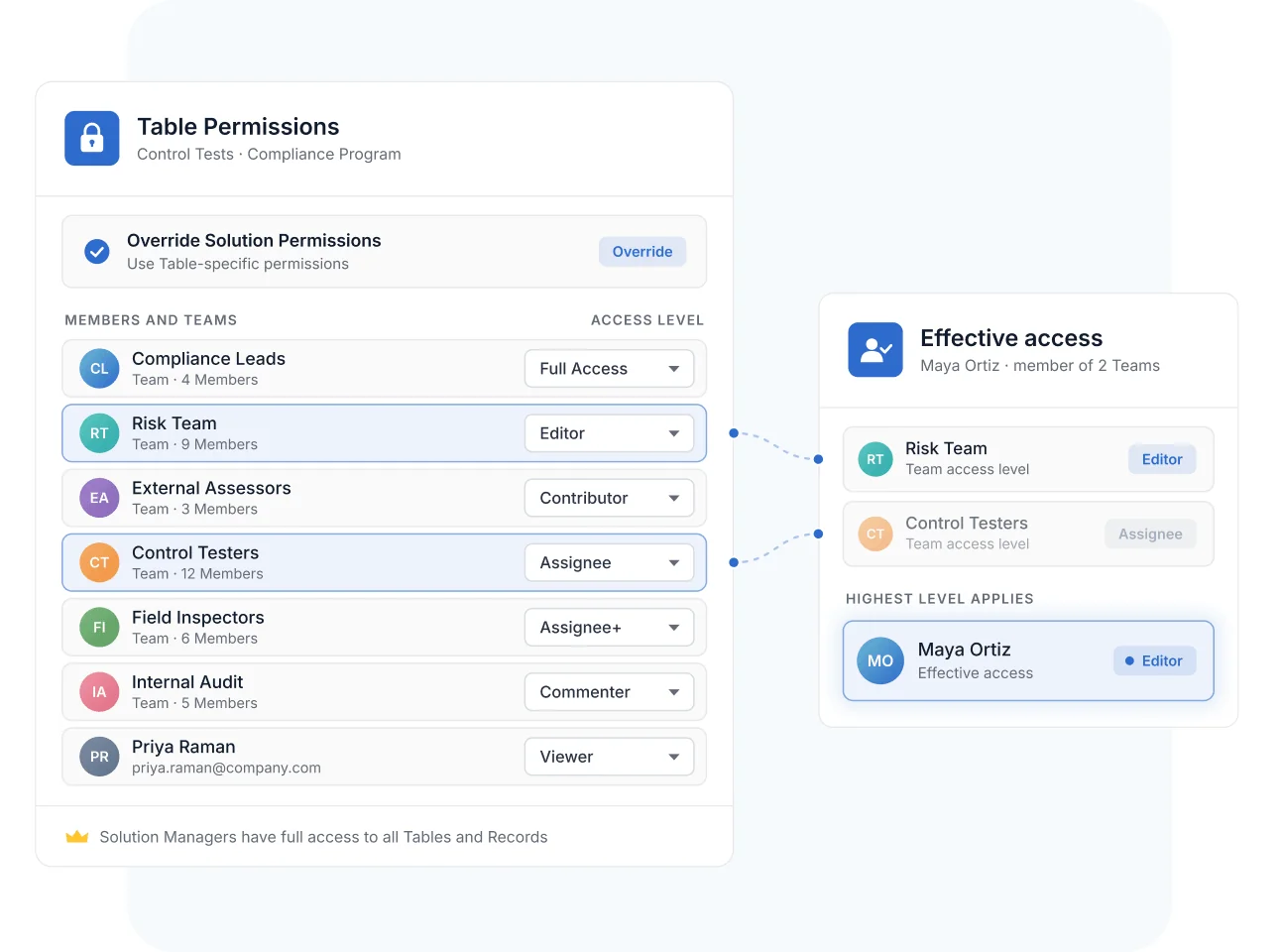
Table Overrides
Override Solution Permissions on Any Table
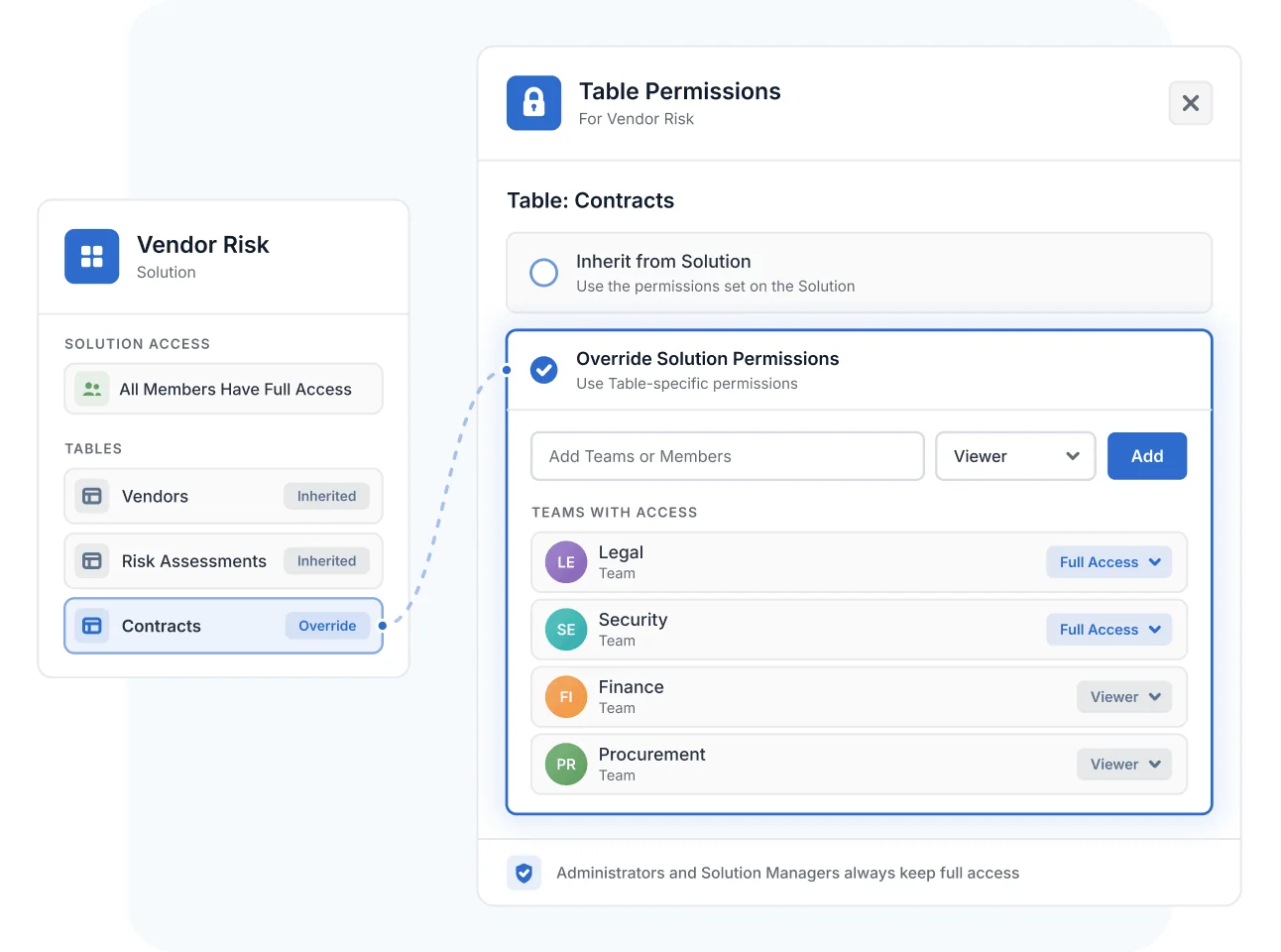
Tables inherit their Solution's permission setting by default—and any Table can override it with its own Member and Team assignments. A Solution open to all Members can still restrict one sensitive Table, like contracts or incident postmortems, to Viewer-only for most Teams while Legal or Security retains Full Access.
Administrators and Solution Managers always keep full access regardless of any override, so governance never locks out the people accountable for it.
Field Permissions
Restrict Field Visibility and Editing Independently
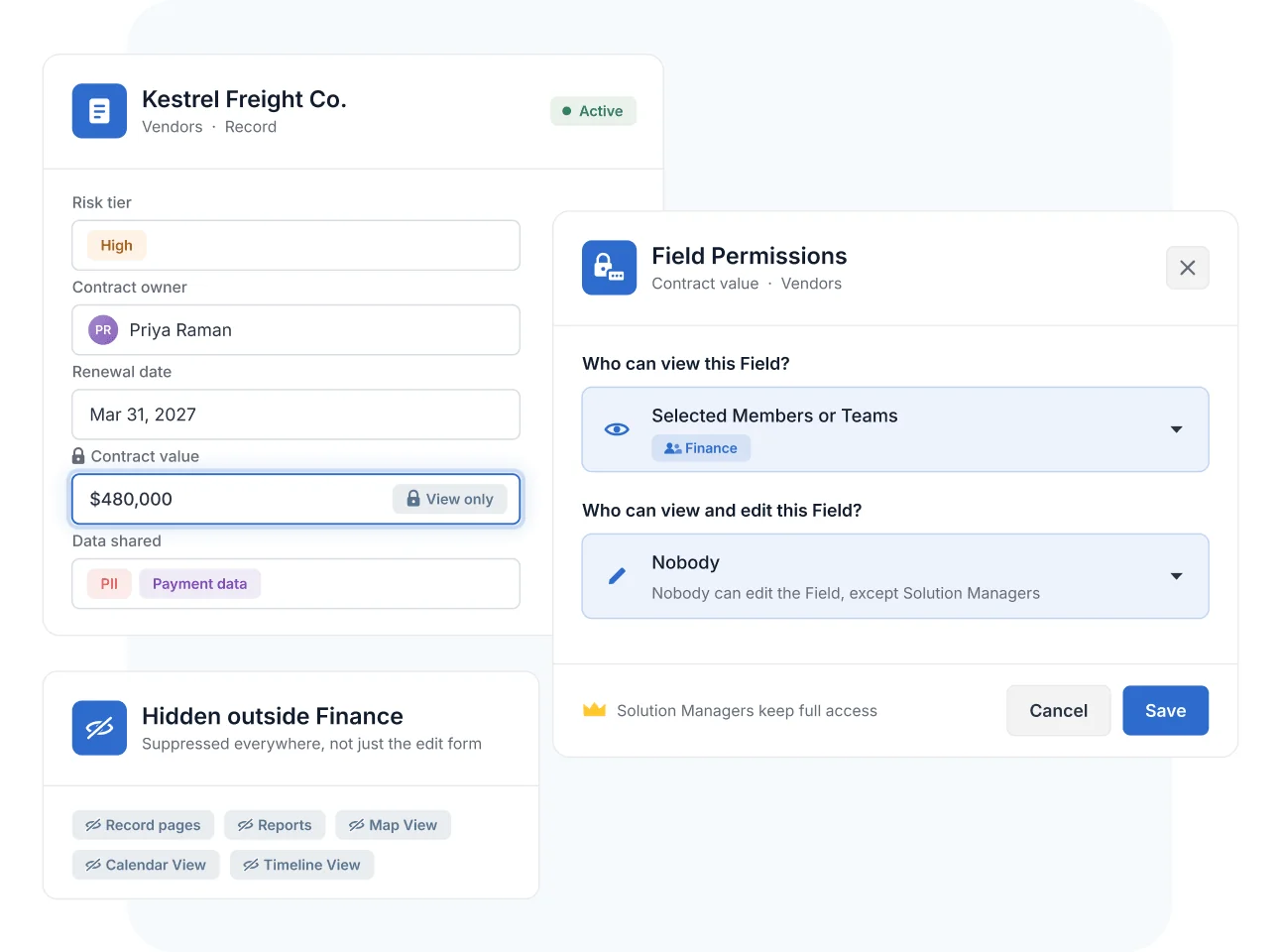
Field Permissions add two independent controls to every Field: who can see it and who can edit it—each set to Everyone, Everyone Except, Selected Members and Teams, or Nobody. A salary Field can be visible to HR but editable by no one; a contract value can disappear entirely for everyone outside Finance.
Hidden Fields are suppressed across the whole platform—record pages, reports, and Map, Calendar, and Timeline views—not just the edit form.
Team-Based Access
Manage Permissions Through Teams, Not Individuals
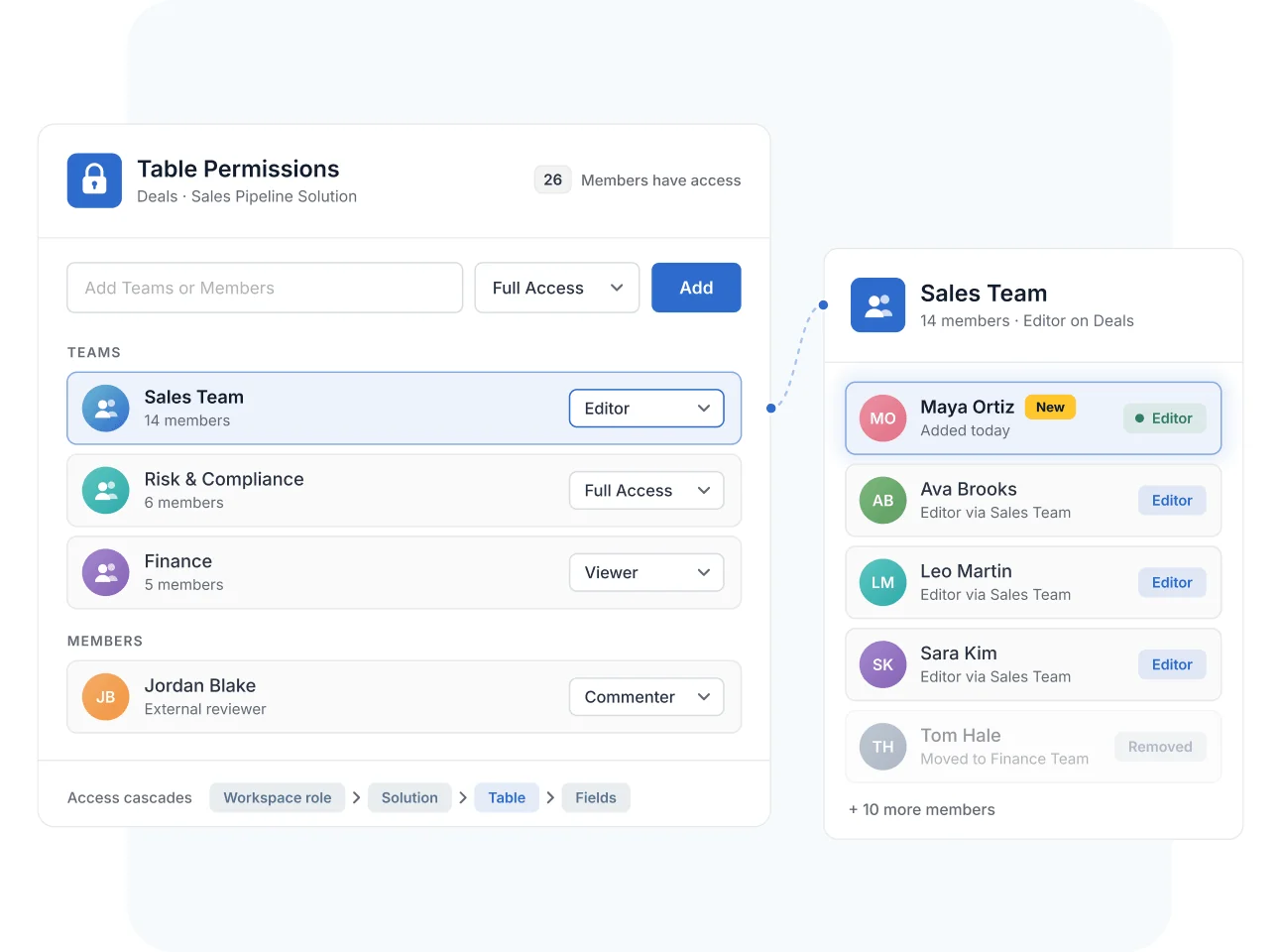
Permissions cascade from workspace roles—General Access, Solution Creator, Administrator—down through Solutions, Tables, and Fields, and the recommended unit of management is the Team. Assign Editor access to the Sales Team once, and every future hire added to that Team inherits it automatically.
Access stays current as people join, move, and leave—without an administrator re-touching every Solution.
Dynamic Access
Grant Access Automatically with Dynamic Record Permissions
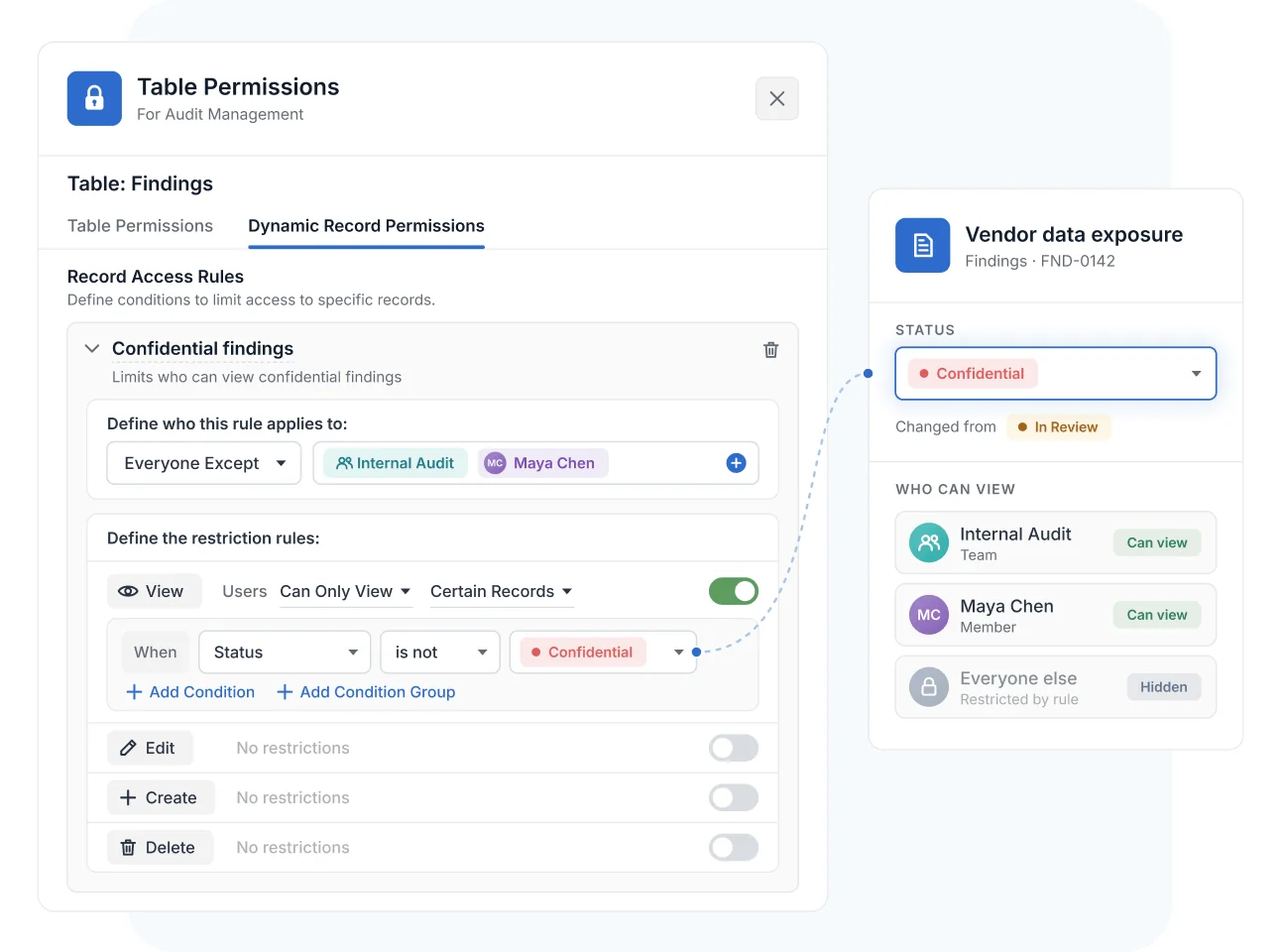
Dynamic Record Permissions add rule-based access on top of static assignments. Solution Managers build table-level rules—authored in plain-language sentence form—that control who can view, edit, create, or delete records based on record values in Status, Single Select, Multiple Select, and Yes/No Fields, with audiences combining Teams and Members through Everyone, Only Selected, or Everyone Except options.
Because rules evaluate the record's values, access follows the data as it changes—a finding that moves to a restricted status locks itself down without anyone touching a setting. Rules scope to the whole record or to selected tabs and sections, and Dynamic Record Permissions are available on the Enterprise plan.
Advanced Permissions
Governed organizations need collaboration and confidentiality in the same workspace. Advanced Permissions gives GRC teams one layered access model across registers, evidence, and policies instead of a patchwork of shared and hidden tools.
Hide compensation, legal exposure, and investigation Fields from everyone except HR and Risk leadership with Field Permissions set to Selected Members and Teams. The rest of the record stays fully collaborative.
Grant external auditors Viewer or Commenter access to control registers and evidence Tables. They review and ask questions in context—without any ability to alter the data under audit.
Restrict a control-testing Table to Assignee access so each tester sees and edits only the controls assigned to them, while the compliance lead retains Full Access through a Table override for program-wide oversight.
Give third-party consultants Contributor access on a shared remediation Table—they create and edit their own records and touch others only when assigned, keeping the rest of the Solution out of reach.
Pair Advanced Permissions with Manage Teams and SCIM Provisioning so directory groups flow into SmartSuite Teams—and permission changes happen automatically when someone changes departments.
Advanced Permissions is SmartSuite's granular access-control system. Administrators and Solution Managers assign access levels—from Full Access down to Viewer—per Member or Team at the Solution and Table level, with independent visibility and edit controls on every Field.
Solution- and Table-level tiers run from Full Access through Editor, Contributor, Assignee, Assignee+, and Commenter to read-only Viewer. Assignee levels limit Members to records assigned to them, and when someone holds multiple levels, the highest applies.
Yes. Field Permissions control visibility and edit rights independently, each set to Everyone, Everyone Except, Selected Members and Teams, or Nobody. Hidden Fields are suppressed everywhere—record pages, reports, and Map, Calendar, and Timeline views. System Fields such as the Title Field and Auto Number cannot be hidden from everyone.
Yes. Tables inherit the Solution's setting by default, and any Table can override it with its own Member and Team assignments—so one sensitive Table can be locked down inside an otherwise open Solution.
SmartSuite recommends assigning permissions to Teams. Access then updates automatically as Team membership changes, which keeps permissions accurate at scale and simplifies access reviews.
Solution, Table, Field, and record-level permissions are available on Team, Professional, and Enterprise plans. Enterprise adds Dynamic Record Permissions and conditional display of Fields, tabs, and sections.
Least-privilege access is a core control in most frameworks. Layered Solution, Table, and Field permissions—assigned to Teams and always subject to Administrator oversight—give auditors a clear, reviewable access model, and Activity History records changes for evidence.
Govern Access Without Slowing Work Down
Set layered permissions once—then let every Team work at full speed inside exactly the guardrails you define.